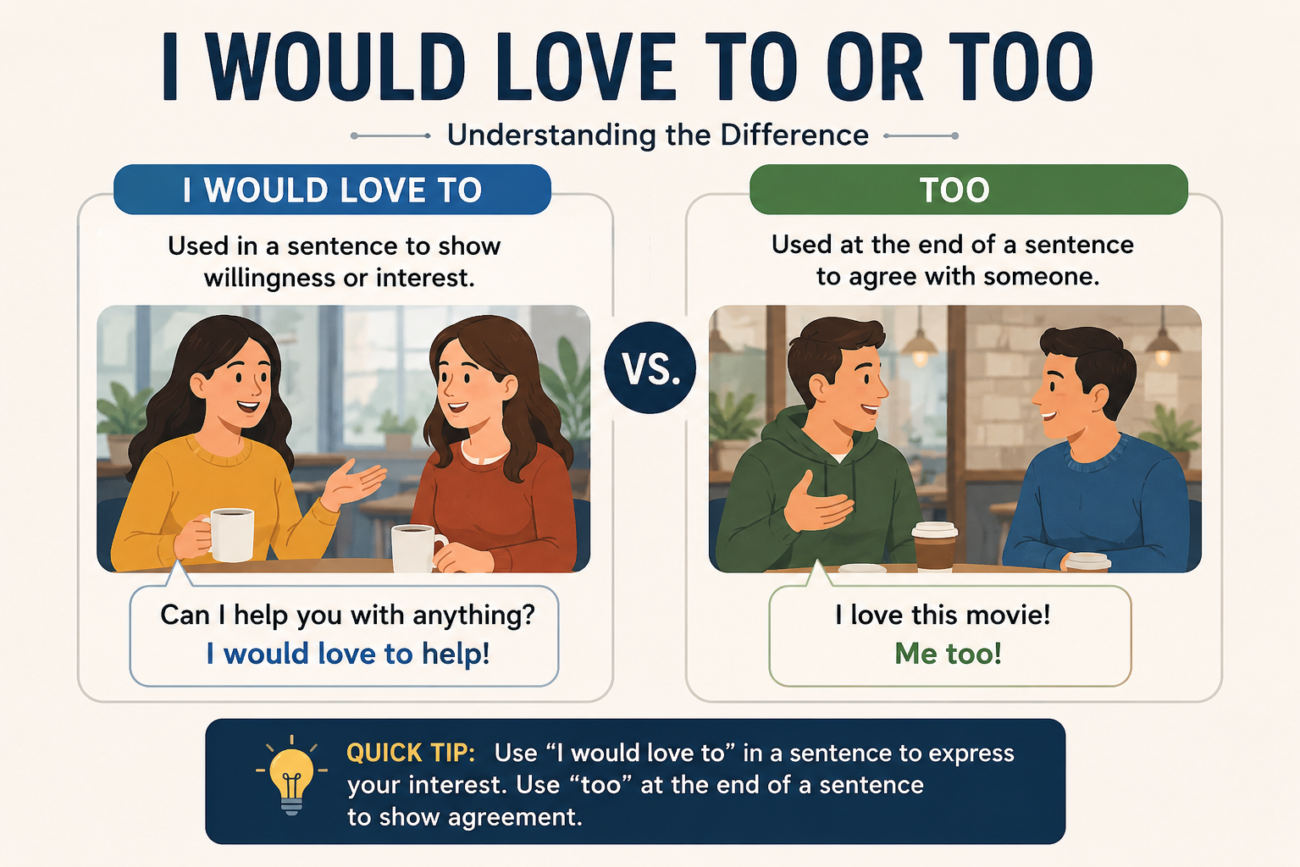
Introduction
Many English learners and even native speakers search for the correct phrase: “I would love to or too?” Although the two words sound identical, they have different meanings and uses. Knowing when to use to and too helps improve your writing, speaking, and overall grammar. This guide explains the correct usage with simple examples, common mistakes, and practical tips to help you avoid confusion.
Is It “I Would Love To” or “I Would Love Too”?
The correct expression is:
✅ I would love to
The word to is part of the infinitive verb structure. It introduces the action you would like to do.
Examples
- I would love to help you.
- I would love to join the meeting.
- I would love to visit Japan.
- I would love to learn Spanish.
- I would love to hear your opinion.
These sentences are grammatically correct because to introduces the following verb.
Why “I Would Love Too” Is Usually Incorrect
The word too means:
- Also
- As well
- More than necessary
Because too does not introduce verbs, writing “I would love too” by itself is usually incorrect.
Incorrect Examples
❌ I would love too help.
❌ I would love too visit.
❌ I would love too learn English.
In each sentence, too should be replaced with to.
Meaning of “To”
The word to has several grammatical functions, but in this phrase it introduces an action.
Examples include:
- To read
- To write
- To travel
- To sing
- To study
Whenever you say “I would love to…”, another verb normally follows.
Meaning of “Too”
The word too has two main meanings.
1. Also
Examples:
- I would love to come too.
- Sarah is coming too.
- I want one too.
Here, too means also.
2. Excessively
Examples:
- The coffee is too hot.
- The bag is too heavy.
- The movie was too long.
In these cases, too means more than desired.
Comparison Table: To vs Too
| Word | Meaning | Example |
|---|---|---|
| To | Introduces a verb or indicates direction | I would love to travel. |
| Too | Means also or excessively | I would love to travel too. |
This simple comparison helps explain why the two words cannot always replace one another.
Common Examples
Below are some correct sentences using to.
- I would love to meet you.
- I would love to work with your team.
- I would love to improve my English.
- I would love to attend the event.
- I would love to try that restaurant.
Now compare them with sentences using too correctly.
- I would love to come too.
- She wants to participate too.
- They enjoyed the concert too.
- We are excited too.
- My brother agrees too.
Notice that too appears after the main idea to mean also.
Common Grammar Mistakes
Many writers accidentally type too instead of to because both words have the same pronunciation.
Here are some common mistakes.
| Incorrect | Correct |
| I would love too help. | I would love to help. |
| I’d love too visit. | I’d love to visit. |
| I want too learn. | I want to learn. |
| Happy too meet you. | Happy to meet you. |
| Nice too see you. | Nice to see you. |
Proofreading your writing can help eliminate these errors.
Easy Trick to Remember
A simple memory tip is:
- If another verb follows, use to.
- If you mean also, use too.
For example:
- I would love to travel.
- I would love to travel too.
The first to introduces the verb.
The second too means also.
Why This Grammar Rule Matters
Using the correct word improves:
Professional Writing
Correct grammar creates a positive impression in emails, resumes, and business communication.
Academic Success
Students receive better grades when grammar mistakes are minimized.
Everyday Communication
Correct usage makes messages easier to understand.
Confidence
Knowing the difference between to and too helps speakers communicate naturally.
Tips to Avoid Confusion
Follow these simple tips.
- Read your sentence aloud.
- Check whether a verb follows.
- Replace too with also to see if it still makes sense.
- Practice writing short sentences.
- Review common grammar mistakes regularly.
These habits quickly improve writing accuracy.
Practice Sentences
Choose the correct word.
- I would love ___ visit London.
- She wants to come ___.
- It is ___ cold outside.
- We hope ___ see you soon.
- They enjoyed the game ___.
Answers
- to
- too
- too
- to
- too
Practicing with examples makes the rule much easier to remember.
FAQs
1. Is “I would love to” grammatically correct?
Yes. “I would love to” is the correct expression when another verb follows.
2. Is “I would love too” correct?
Not by itself. It is usually incorrect unless too means also, as in “I would love to come too.”
3. What does “too” mean?
It usually means also or more than necessary.
4. Why do people confuse “to” and “too”?
They sound exactly the same when spoken, making them one of the most common spelling mistakes in English.
5. How can I remember the difference?
Use to before a verb and too when you mean also or excessively.
Conclusion
Understanding the difference between “I would love to or too” is one of the simplest ways to improve your English grammar. In nearly every situation where a verb follows, “I would love to” is the correct phrase. The word too should only be used when it means also or more than enough. By remembering this easy rule and practicing with everyday examples, you’ll write more confidently, avoid common mistakes, and communicate more clearly in both personal and professional settings.
